Sunday, November 29, 2015
ch17
Ch17
TS48-68
?MS567-604
written Feb 1905 [L2-81] (JAJ started wearing glasses again at this point, after ten years of nearsightedness)
Maurice forbidden walks, SD threatened with withdrawal of support
SD determined to live, rejoices in self-centeredness
finds solitude restful, making friends at school
writing paper to try and win converts
SD debates McCann's theories-- Socratic dialog
SD trembles to think of McCann's "unhorizoned doggedness working its way backwards" [ = frigging??? unhorizoned = shortsighted? backwards to virginity? to the womb?! sex is the spirit working backwards to womb??]
license as a sin against the future
Ibsen not a moralist
SD feigns interest in Irish to get close to Emma, via Madden
SD hates church more than English, Madden panders to church for support
SD sees no gain in Irish language
others adjust to idea of SD studying Irish
Maurice's retreat, SD marvels how far he's come, Maurice's seriousness
no 'companions'-- fear of SD?
Maurice's prosaic self-contemplation appalls SD
Wed night Irish class, Mr Hughes
the word for 'love' discomfits a young man
Citizen, Madden, Griffith in Cooney's
nationalism as bogus fraud
Bacon quote: [etext]
Silas Verney: historical novel of 17th C by Edgar Pickering
JAJ and JFB attend Gaelic meeting May 1900 [historical context]
Stannie's retreat Dec 1898
28Feb to Stannie: "It seems to me that what astonishes most people in the length of the novel is the extraordinary energy in the writer and his extraordinary patience. It would be easy for me to do short novels if I chose but what I want to wear away in this novel cannot be worn away except by constant dropping. Gogarty used to pipe '63' in treble when I told him the number of the chapters. I am not quite satisfied with the title 'Stephen Hero' and am thinking of restoring the original title of the article 'A Portrait of the Artist' or perhaps better 'Chapters in the Life of a Young Man'." [SL56]

Friday, November 27, 2015
ch17a
17 17a 17b 17c 17d 17e 17f 17g 17h
Stephen's home-life had by this time grown sufficiently unpleasant: the direction of his development was against the stream of tendency of his family. The evening walks with Maurice had been prohibited for it had become evident that Stephen was corrupting his brother to idle habits. Stephen was harassed very much by enquiries as to his progress at the College and Mr Daedalus, meditating upon the evasive answers, had begun to express a fear that his son was falling into bad company. The youth was given to understand that if he did not succeed brilliantly at the coming examination his career at the University would come to a close. He was not greatly troubled by this warning for he knew that his fate was, in this respect, with his godfather and not with his father. He felt that the moments of his youth were too precious to be wasted in a dull mechanical endeavour and he determined, whatever came of it, to prosecute his intentions to the end. His family expected that he would at once follow the path of remunerative respectability and save the situation but he could not satisfy his family. He thanked their intention: it had first fulfilled him with egoism; and he rejoiced that his life had been so self-centred. He felt however that there were activities which it a would be a peril to postpone.
Maurice accepted this prohibition with a bad grace and had to be restrained by his brother from overt disobedience. Stephen himself bore it lightly because he could ease himself greatly in solitude and for human channels, at the worst, he could resort to a few of his college-companions. He was now busily preparing his paper for the Literary and Historical Society and he took every precaution to ensure in it a maximum of explosive force. It seemed to him that the students might need only the word to enkindle them towards liberty or that, at least, his trumpet-call might bring to his side a certain minority of the elect. McCann was the Auditor of the Society and as he was anxious to know the trend of Stephen's paper the two used often to leave the Library at ten o'clock and walk towards the Auditor's lodgings, discussing. McCann enjoyed the reputation of a fearless, free-spoken young man but Stephen found it difficult to bring him to any fixed terms on matters which were held to be dangerous ground. McCann would talk freely on feminism and on rational life: he believed that the sexes should be educated together in order to accustom them early to each other's influences and he believed that women should be afforded the same opportunities as were afforded to the so-called superior sex and he believed that women had the right to compete with men in every branch of social and intellectual activity. He also held the opinion that a man should live without using any kind of stimulant, that he had a moral obligation to transmit to posterity sound minds in sound bodies, and that he should not allow himself to be dictated to on the subject of dress by any conventions. Stephen delighted to riddle these theories with agile bullets.
Ellmann says the Auditor was Arthur Clery (31yo barrister in 1911)
 |
| 21yo in 1901 |
Skeffington [1909 map] [1901 census] ('Roman Catholic Professor of Languages')
— You would have no sphere of life closed to them?
— Certainly not.
— Would you have the soldiery, the police and the fire-brigade recruited also from them?
— There are certain social duties for which women are physically unfitted.
— I believe you.
— At the same time they should be allowed to follow any civil profession for which they have an aptitude.
— Doctors and lawyers?
— Certainly.
— And what about the third learned profession?
— How do you mean?
— Do you think they would make good confessors?
— You are flippant. The Church does not allow women to enter the priesthood.
— O, the Church!
17 17a 17b 17c 17d 17e 17f 17g 17h
Wednesday, November 25, 2015
ch17b
17 17a 17b 17c 17d 17e 17f 17g 17h
Whenever the conversation reached this point McCann refused to follow it further. The discussions usually ended in a deadlock:
— But you go mountain-climbing in search of fresh air?
— Yes.
— And bathing in the summertime?
— Yes.
— And surely the mountain air and the salt water act as stimulants!
— Natural stimulants, yes.
— What do you call an unnatural stimulant?
— Intoxicating drinks.
— But they are produced from natural vegetable substances, aren't they?
— Perhaps, but by an unnatural process.
— Then you regard a brewer as a high thaumaturgist?
— Intoxicating drinks are manufactured to satisfy artificially induced appetites. Man, in the normal condition, has no need for such props to life.
— Give me an example of man in what you call 'the normal condition.'
— A man who lives a healthy, natural life.
— Yourself?
— Yes.
— Do you then represent normal humanity?
— I do.
— Then is normal humanity short-sighted and tone-deaf?
— Tone-deaf?
— Yes: I think you are tone-deaf.
— I like to hear music.
— What music?
— All music.
— But you cannot distinguish one air from another.
— No: I can recognise some airs.
— For instance?
— I can recognise 'God save the Queen.'
— Perhaps because all the people stand up and take off their hats.
— Well, admit that my ear is a little defective.
— And your eyes?
— They too.
— Then how do you represent normal humanity?
— In my manner of life.
17 17a 17b 17c 17d 17e 17f 17g 17h
Monday, November 23, 2015
ch17c
17 17a 17b 17c 17d 17e 17f 17g 17h
— Your wants and the manner in which you satisfy them,
— Exactly.
— And what are your wants?
— Air and food.
— Have you any subsidiary ones?
— The acquisition of knowledge.
— And you need also religious comforts?
— Maybe so... at times.
— And women... at times?
— Never!
This last word was uttered with a moral snap of the jaws and in such a business-like tone of voice that Stephen burst out into a fit of loud laughter. As for the fact, though he was very suspicious in this matter, Stephen was inclined to believe in McCann's chastity and much as he disliked it he chose to contemplate it rather than the contrary phenomenon. He almost trembled to think of that unhorizoned doggedness working its way backwards.
McCann's insistence on a righteous life and his condemnation of licence as a sin against the future both annoyed and stung Stephen. It annoyed him because it savoured so strongly of paterfamilias and it stung him because it seemed to judge him incapable of that part. In McCann's mouth he considered it unjust and unnatural and he fell back on a sentence of Bacon's. The care of posterity, he quoted, is greatest in them that have no posterity: and for the rest he said that he could not understand what right the future had to hinder him from any passionate exertions in the present.
— That is not the teaching of Ibsen, said McCann.
— Teaching! cried Stephen.
— The moral of Ghosts is just the opposite of what you say.
— Bah! You regard a play as a scientific document.
— Ghosts teaches self-repression.
— O Jesus! said Stephen in agony.
— This is my lodging, said McCann, halting at the gate. I must go in.
— You have connected Ibsen and Eno's fruit salt forever in my mind, said Stephen.

— Daedalus, said the Auditor crisply, you are a good fellow but you have yet to learn the dignity of altruism and the responsibility of the human individual.
17 17a 17b 17c 17d 17e 17f 17g 17h
Saturday, November 21, 2015
ch17d
17 17a 17b 17c 17d 17e 17f 17g 17h
Stephen had decided to address himself to Madden to ascertain where Miss Clery was to be found. He set about this task carefully. Madden and he were often together but their conversations were rarely serious and though the rustic mind of one was very forcibly impressed by the metropolitanism of the other both young men were on relations of affectionate familiarity. Madden who had previously tried in vain to infect Stephen with nationalistic fever was surprised to hear these overtures of his friend. He was delighted at the prospect of making such a convert and he began to appeal eloquently to the sense of justice. Stephen allowed his critical faculty a rest. The so-desired community for the realising of which Madden sought to engage his personal force seemed to him anything but ideal and the liberation which would have satisfied Madden would by no means have satisfied him. The Roman, not the Sassenach, was for him the tyrant of the islanders: and so deeply had the tyranny eaten into all souls that the intelligence, first overborne so arrogantly, was now eager to prove that arrogance its friend. The watchcry was Faith and Fatherland, a sacred word in that world of cleverly inflammable enthusiasms. With literal obedience and with annual doles the Irish bid eagerly for the honour which was studiously withheld from them to be given to nations which in the past, as in the present, had never bent the knee but in defiance. While the multitude of preachers assured them that high honours were on the way and encouraged them ever to hope. The last should be first, according to the Christian sentiment, and whosoever humbled himself, exalted and in reward for several centuries of obscure fidelity the Pope's Holiness had presented a tardy cardinal to an island which was for him, perhaps, only the afterthought of Europe.
Madden was prepared to admit the truth of much of this but he gave Stephen to understand that the new movement was politic. If the least infidelity were hoisted on the standard the people would not flock to it and for this reason the promoters desired as far as possible to work hand in hand with the priests. Stephen objected that this working hand in hand with the priests had over and over again ruined the chances of revolutions. Madden agreed: but now at least the priests were on the side of the people.
— Do you not see, said Stephen, that they encourage the study of Irish that their flocks may be more safely protected from the wolves of disbelief; they consider it is an opportunity to withdraw the people into a past of literal, implicit faith?
— But really our peasant has nothing to gain from English Literature.
— Rubbish!
— Modern at least. You yourself are always railing...
— English is the medium for the Continent.
— We want an Irish Ireland.
— It seems to me you do not care what banality a man expresses so long as he expresses it in Irish.
— I do not entirely agree with your modern notions. We want to have nothing of this English civilisation.
— But the civilisation of which you speak is not English — it is Aryan. The modern notions are not English; they point the way of Aryan civilisation.
— You want our peasants to ape the gross materialism of the Yorkshire peasant?
— One would imagine the country was inhabited by cherubim. Damme if I see much difference in peasants: they all seem to me as like one another as a peascod is like another peascod. The Yorkshireman is perhaps better fed.

— Of course you despise the peasant because you live in the city.
— I don't despise his office in the least.
— But you despise him — he's not clever enough for you.
— Now, you know, Madden that's nonsense. To begin with he's as cute as a fox — try to pass a false coin on him and you'll see. But his cleverness is all of a low order. I really don't think that the Irish peasant represents a very admirable type of culture.
— That's you all out! Of course you sneer at him because he's not up-to-date and lives a simple life.
— Yes, a life of dull routine — the calculation of coppers, the weekly debauch and the weekly piety — a life lived in cunning and fear between the shadows of the parish chapel and the asylum!
— The life of a great city like London seems to you better?
— The intelligence of an English city is not perhaps at a very high level but at least it is higher than the mental swamp of the Irish peasant.
— And what about the two as moral beings?
— Well?
— The Irish are noted for at least one virtue all the world over.
— Oho! I know what's coming now!
— But it's a fact — they are chaste.
— To be sure.
— You like to run down your own people at every hand's turn but you can't accuse them...
— Very good: you are partly right. I fully recognise that my countrymen have not yet advanced as far as the machinery of Parisian harlotry because...
— Because...?
— Well, because they can do it by hand, that's why!
— Good God, you don't mean to say you think...
— My good youth, I know what I am saying is true and so do you know it. Ask Father Pat and ask Dr Thisbody and ask Dr Thatbody. I was at school and you were at school — and that's enough about it.
— O, Daedalus!
This accusation laid a silence on the conversation. Then Madden spoke:
— Well, if these are your ideas I don't see what you want coming to me and talking about learning Irish.
— I would like to learn it — as a language, said Stephen lyingly. At least I would like to see first.
— So you admit you are an Irishman after all and not one of the red garrison.
— Of course I do.
— And don't you think that every Irishman worthy of the name should be able to speak his native tongue?
— I really don't know.
— And don't you think that we as a race have a right to be free?
— O, don't ask me such questions, Madden. You can use these phrases of the platform but I can't.
— But surely you have some political opinions, man!
— I am going to think them out. I am an artist, don't you see? Do you believe that I am?
— O, yes, I know you are.
— Very well then, how the devil can you expect me to settle everything all at once? Give me time.
So it was decided that Stephen was to begin a course of lessons in Irish. He bought the O'Growney's primers published by the Gaelic League but refused either to pay a subscription to the League or to wear the badge in his buttonhole. He had found out what he had desired, namely, the class in which Miss Clery was. People at home did not seem opposed to this new freak of his. Mr Casey taught him a few Southern songs in Irish and always raised his glass to Stephen saying "Sinn Fein" instead of "Good Health." Mrs Daedalus was probably pleased for she thought that the superintendence of priests and the society of harmless enthusiasts might succeed in influencing her son in the right direction: she had begun to fear for him. Maurice said nothing and asked no questions. He did not understand what made his brother associate with the patriots and he did not believe that the study of Irish seemed in any way useful to Stephen: but he was silent and waited. Mr Daedalus said that he did not mind his son's learning the language so long as it did not keep him from his legitimate work.
17 17a 17b 17c 17d 17e 17f 17g 17h
Thursday, November 19, 2015
ch17e
17 17a 17b 17c 17d 17e 17f 17g 17h
One evening when Maurice came back from school he brought with him the news that the retreat would begin in three days' time. This news suddenly delivered showed Stephen his position. He could hardly believe that in a year his point of view had changed so completely. Only twelve months ago he had been clamouring for forgiveness and promising endless penances. He could hardly believe that it was no other than he who had clung so fiercely to the sole means of salvation which the Church vouchsafes to her guilty children. He marvelled at the terror which had then possessed him. One evening during the retreat he asked his brother what kind of sermons the priest was giving. The two were standing together looking into the window of a stationer's shop and it was a picture of S. Anthony in the window which had led to the question. Maurice smiled broadly as he answered:
— Hell today.
— And what kind of a sermon was it?
— Usual kind of thing. Stink in the morning and pain of loss in the evening.
Stephen laughed and looked at the square-shouldered boy beside him. Maurice announced facts in a dry satirical voice and his cloudy complexion did not change colour when he laughed. He made Stephen think of the pictures in 'Silas Verney.' His sombre gravity, his careful cleansing of his much-worn clothes, and the premature disillusionment of his manner all suggested the human vesture of some spiritual or philosophic problem transplanted from Holland. Stephen did not know in what stage the problem was and he thought it wiser to allow it its own path of solution.

— Do you know what the priest told us also? asked Maurice after a pause.
— What?
— He said we weren't to have companions.
— Companions?
— That we weren't to go for walks in the evenings with any special companions. If we wanted to take a walk, he said, a lot of us were to go together.
Stephen halted in the street and struck the palms of his hands together.
— What's up with you? said Maurice.
— I know what's up with them, said Stephen. They're afraid.
— Of course they're afraid, said Maurice gravely.
— By the bye of course you have made the retreat?
— O, yes. I'm going to the altar in the morning.
— Are you really?
— Tell the truth, Stephen. When mother gives you the money on Sunday to go in to short twelve in Marlboro' St do you really go to Mass?
Stephen coloured slightly.
— Why do you ask that?
— Tell the truth.
— No... I don't.
— And where do you go?
— O anywhere... about the town.
— So I thought.
— You're a 'cute fellow, said Stephen in a sidewise fashion. Might I ask do you go to mass yourself?
— O, yes, said Maurice.
They walked on for a short time in silence. Then Maurice said:
— I have bad hearing.
Stephen made no remark.
— And I think I must be a little stupid.
— How's that?
In his heart Stephen felt that he was condemning his brother. In this instance he could not admit that freedom from strict religious influences was desirable. It seemed to him that anyone who could contemplate the condition of his soul in such a prosaic manner was not worthy of freedom and was fit only for the severest shackles of the Church.
— Well today the priest was telling us a true story. It was about the death of the drunkard. The priest came in to see him and talked to him and asked him to say he was sorry and to promise to give up drink. The man felt that he was going to die in a few moments but he sat upright in the bed, the priest said, and pulled out a black bottle from under the bedclothes
— Well?
— And said "Father, if this was to be the last I was ever to drink in this world I must drink it."
— Well?
— So he drained the bottle dry. That very moment he dropped dead, said the priest lowering his voice. "That man fell dead in the bed, stone dead. He died and went..." He spoke so low that I couldn't hear but I wanted to know where the man went so I leaned forward to hear and hit my nose a wallop against the bench in front. While I was rubbing it the fellows knelt down to say the prayer so I didn't hear where he went. Amn't I stupid?
Stephen exploded ill laughter. He laughed so loudly that the people who were passing turned to look at him and had to smile themselves by attraction. He put his hands to his sides and the tears almost fell out of his eyes. Every glimpse he caught of Maurice's solemn olive-coloured face set him off on a new burst. He could say nothing between times but — "I'd have given anything to have seen it — 'Father, if this was the last' ...and you with your mouth open. I'd have given anything to have seen it."
17 17a 17b 17c 17d 17e 17f 17g 17h
Tuesday, November 17, 2015
ch17f
17 17a 17b 17c 17d 17e 17f 17g 17h
The Irish class was held every Wednesday night in a back room on the second floor of a house in O'Connell St. The class consisted of six young men and three young women. The teacher was a young man in spectacles with a very sick-looking face and a very crooked mouth. He spoke in a high-pitched voice and with a cutting Northern accent. He never lost an opportunity of sneering at seoninism and at those who would not learn their native tongue. He said that Beurla was the language of commerce and Irish the speech of the soul and he had two witticisms which always made his class laugh. One was the 'Almighty Dollar' and the other was the 'Spiritual Saxon.' Everyone regarded Mr Hughes as a great enthusiast and some thought he had a great career before him as an orator. On Friday nights when there was a public meeting of the League he often spoke but as he did not know enough Irish he always excused himself at the beginning of his speech for having to speak to the audience in the language of the 'Spiritual Saxon.' At the end of every speech he quoted a piece of verse. He scoffed very much at Trinity College and at the Irish Parliamentary Party. He could not regard as patriots men who had taken oaths of allegiance to the Queen of England and he could not regard as a national university an institution which did not express the religious convictions of the majority of the Irish people. His speeches were always loudly applauded and Stephen heard some of the audience say that they were sure he would be a great success at the bar. On enquiry, Stephen found that Hughes, who was the son of a Nationalist solicitor in Armagh, was a law-student at the King's Inns.
Hughes??? 1901
O'Connell avenue 1909
The Irish class which Stephen attended was held in a very sparely furnished room lit by a gasjet which had a broken globe. Over the mantelpiece hung the picture of a priest with a beard who, Stephen found, was Father O'Growney. It was a beginners' class and its progress was retarded by the stupidity of two of the young men. The others in the class learned quickly and worked very hard. Stephen found it very troublesome to pronounce the gutturals but he did the best he could. The class was very serious and patriotic. The only time Stephen found it inclined to levity was at the lesson which introduced the word 'gradh.' The three young women laughed and the two stupid young men laughed, finding something very funny in the Irish word for 'love' or perhaps in the notion itself. But Mr Hughes and the other three young men and Stephen were all very grave. When the excitement of the word had passed Stephen's attention was attracted to the younger of the stupid young men who was still blushing violently. His blush continued for such a long time that Stephen began to feel nervous. The young man grew more and more confused and what was worst was that he was making all this confusion for himself for no-one in the class but Stephen seemed to have noticed him. He continued so till the end of the hour never once daring to raise his eyes from his book and when he had occasion to use his handkerchief he did so stealthily with his left hand.
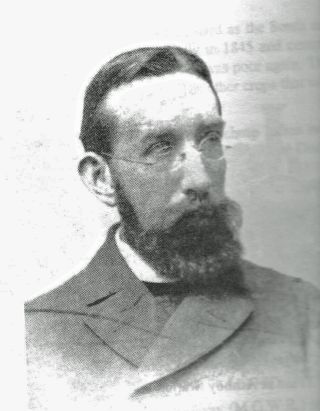 |
| O'Growney |
The meetings on Friday nights were public and were largely patronised by priests. The organisers brought in reports from different districts and the priests made speeches of exhortation. Two young men would then be called on for songs in Irish and when it was time for the whole company to break up all would rise and sing the Rallying-Song. The young women would then begin to chatter while their cavaliers helped them into their jackets. A very stout black-bearded citizen who always wore a wideawake hat and a long bright green muffler was a constant figure at these meetings. When the company was going home he was usually to be seen surrounded by a circle of young men who looked very meagre about his bulk. He had the voice of an ox and he could be heard at a great distance, criticising, denouncing and scoffing. His circle was the separatist centre and in it reigned the irreconcilable temper. It had its headquarters in Cooney's tobacco-shop where the members sat every evening in the 'Divan' talking Irish loudly and smoking churchwardens. To this circle Madden who was the captain of a club of hurley-players reported the muscular condition of the young irreconcilables under his charge and the editor of the weekly journal of the irreconcilable party reported any signs of Philocelticism which he had observed in the Paris newspapers.
By all this society liberty was held to be the chief desirable; the members of it were fierce democrats. The liberty they desired for themselves was mainly a liberty of costume and vocabulary: and Stephen could hardly understand how such a poor scarecrow of liberty could bring serious human beings to their knees in worship. As in the Daniels' household he had seen people playing at being important so here he saw people playing at being free. He saw that many political absurdities arose from the lack of a just sense of comparison in public men. The orators of this patriotic party were not ashamed to cite the precedents of Switzerland and France. The intelligent centres of the movement were so scantily supplied that the analogies they gave out as exact and potent were really analogies built haphazard upon very inexact knowledge. The cry of a solitary Frenchman (A bas l'Angleterre!) at a Celtic re-union in Paris would be made by these enthusiasts the subject of a leading article in which would be shown the imminence of aid for Ireland from the French Government. A glowing example was to be found for Ireland in the case of Hungary, an example, as these patriots imagined, of a long-suffering minority, entitled by every right of race and justice to a separate freedom, finally emancipating itself. In emulation of that achievement bodies of young Gaels conflicted murderously in the Phoenix Park with whacking hurley-sticks, thrice armed in their just quarrel since their revolution had been blessed for them by the Anointed, and the same bodies were set aflame with indignation by the unwelcome presence of any young sceptic who was aware of the capable aggressions of the Magyars upon the Latin and Slav and Teutonic populations, greater than themselves in number, which are politically allied to them, and of the potency of a single regiment of infantry to hold in check a town of twenty thousand inhabitants.
17 17a 17b 17c 17d 17e 17f 17g 17h
Subscribe to:
Posts (Atom)